

The short version: earthquakes often exceed design levels. Tanks hold up best when the whole system, from tank to anchors to foundation, is designed so any damage happens in a part that’s easy to inspect and replace.
What does real earthquake damage tell us about how aboveground storage tanks actually behave? Brayden Reynolds, Structural Engineer at Onguard Seismic Systems, put that question to engineers, tank manufacturers and inspection specialists at the 2026 API Inspection and Mechanical Integrity Summit (IMIS). The summit ran July 20–23, 2026, in San Antonio, Texas.
Seismic codes give engineers a sound framework. Earthquakes keep teaching us how to meet that framework in ways that hold up in the field. Here’s what the damage record shows.
TANK ANCHORAGE AND UPLIFT: THE LOAD PATH IS ONE SYSTEM
In an earthquake, a tank rocks and its base lifts. The anchors take that load, but they don’t fail alone.
Observed damage includes anchor fracture and elongation, anchor-chair and connection damage, concrete breakout, foundation distress, and local buckling or tearing of the shell.
Tension-only anchors can also “ratchet.” As the overturning direction reverses through repeated cycles, they stretch permanently. That allows more uplift with each cycle and puts extra deformation and compression into the shell when the tank comes back down.
The lesson is to treat the load path as a complete system, from the shell or skirt, through the anchorage, into the foundation. Give it a clear hierarchy so that any intended yielding happens in a controlled, inspectable component before damage develops anywhere else.
This builds on the API 650 design approach. It adds a look at how the whole system behaves under repeated cycles and under shaking above the design level.
DUCTILITY BELONGS TO THE WHOLE LOAD PATH
Ductility is often treated as a property of the anchor material. In practice, it has to be a property of the entire load path.
An anchor that can yield doesn’t guarantee a ductile system if the shell, connection, embedment or foundation reaches its limit first. A tension-only anchor can also yield exactly as intended and still lose its ability to control movement as it gets longer with every cycle.
A ductile anchor is the starting point. The yield mechanism also needs to be deliberate, stable under cyclic loading, and supported by capacity design of the surrounding components.
DESIGN-LEVEL VS. EXPERIENCED ACCELERATIONS: KAIKOURA 2016
During the 2016 Kaikōura earthquake in New Zealand, the recorded 0.2-second spectral acceleration at the relevant site was about 70% above the applicable design level. Roughly 15 to 20 response peaks exceeded that level.
Design standards define a design basis, not an absolute maximum earthquake. The real test is how a structure behaves once that threshold is crossed, and through the repeated cycles that follow.
At Kaikōura, tanks fitted with Onguard’s buckling-restrained anchorage remained operational. Tanks with traditional anchorage lost significant storage capacity.
REPAIR OR REPLACE
The decision comes down to where the inelastic deformation and damage occurred.
Sometimes yielding stays in a replaceable anchorage component, and the shell, bottom plate, welds, foundation and piping remain within acceptable limits. Then the tank can be inspected, the affected components replaced, and the tank returned to service relatively quickly.
Replacement becomes more likely with significant shell buckling, tearing or cracking at the shell-to-bottom connection, permanent distortion or loss of dimensional tolerances, weld damage, excessive settlement or tilt, foundation failure, or damage to nozzles and connected piping.
Leakage, contamination, fatigue history, inspectability and the ability to demonstrate continued fitness for service also count.
The question isn’t whether the tank is still standing. It’s whether its load path, geometry, strength and serviceability can be reliably restored.
THE TAKEAWAY FOR TANK SEISMIC DESIGN
Code-compliant design and good field performance go hand in hand when load path, detailing and calculation assumptions reflect how the tank will really behave when the ground moves.
That’s the thinking behind Onguard’s anchorage systems: code-compliant, proven in real earthquakes including Kaikōura, and built to protect people, product and the facilities that hold them.
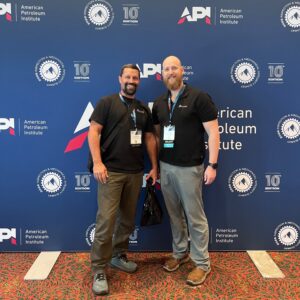
Thanks to API for the invitation to contribute, and to everyone who joined the technical discussion in San Antonio.
Questions about seismic anchorage for your tanks? Talk to our engineering team.